
Spend a morning reading renovation ROI articles and you will come away with a tidy set of percentages: this project returns 75 percent, that one returns 100 percent, this other one pays for itself twice over. Most of those numbers are either unsourced, quietly borrowed from U.S. reports, or attributed to organizations that never published them. None of them are about Burlington. The honest version is less tidy and more useful, and it starts with a word most of these lists get wrong.
”ROI” on a renovation is usually recovery, not return
Return on investment implies you end up with more money than you started with. Almost no renovation does that once you count materials, labour, and the time your money was tied up. What a good renovation does is recover a share of its cost when you sell. That is a partial refund on money already spent, not a gain.
The distinction matters because it changes how you should read every figure below. When a report says a kitchen renovation “returns 100 percent,” it means the project tended to recover roughly what it cost, not that it earned you a profit. Framing it as recovery rate, not return rate keeps expectations honest and stops you from over-spending on the theory that the money comes back with interest. It almost never does.
None of the credible Canadian sources reviewed for this post claim that a typical renovation fully repays its cost, let alone clears a profit. The most disciplined way to budget is to decide what a project is worth to you for the years you will live with it, then treat whatever you recover at resale as a bonus.
What the data actually says adds value
Across Canadian sources, the same handful of projects keeps landing on top. The Appraisal Institute of Canada, whose members are the professionals lenders rely on to value homes, ranks the top return-generating renovations as kitchens, bathrooms, interior and exterior repainting, updating décor (lighting and plumbing fixtures, countertops, flooring), and decluttering. Worth being precise here: the AIC brochure gives a qualitative ranking only. It does not publish recovery percentages, despite a lot of websites claiming it does. If you see “the AIC says kitchens return 75 to 100 percent,” that number was invented somewhere downstream.
Two Canadian broker surveys point the same direction, and both are from 2022, so read them as dated sentiment rather than current-year figures. A Royal LePage report, surveying 340 of its brokers and agents in early 2022, estimated the average value increase from a kitchen renovation at about 20 percent, a bathroom at about 16 percent, a finished basement or basement apartment at about 15 percent, window replacement at about 13 percent, interior painting at about 12 percent, outdoor entertaining and landscaping at about 10 percent, and a pool at about 6 percent. A separate RE/MAX Canada renovation report from January 2022 found the same ordering: a large majority of the brokers it surveyed named kitchens the strongest renovation for return, with bathrooms second.
Notice what sits at the bottom of the Royal LePage list. A pool, one of the most expensive things you can add to a property, drew the smallest estimated value bump of the group. That is the pattern worth remembering: the cheap, functional, universally liked updates tend to recover better than the large, personal, expensive ones.
Adding value, preserving value, and buying enjoyment are three different things
The AIC brochure is careful to keep three ideas apart, and conflating them is where a lot of renovation budgets go sideways.
- Projects that tend to add value: kitchens, bathrooms, painting, décor updates, decluttering.
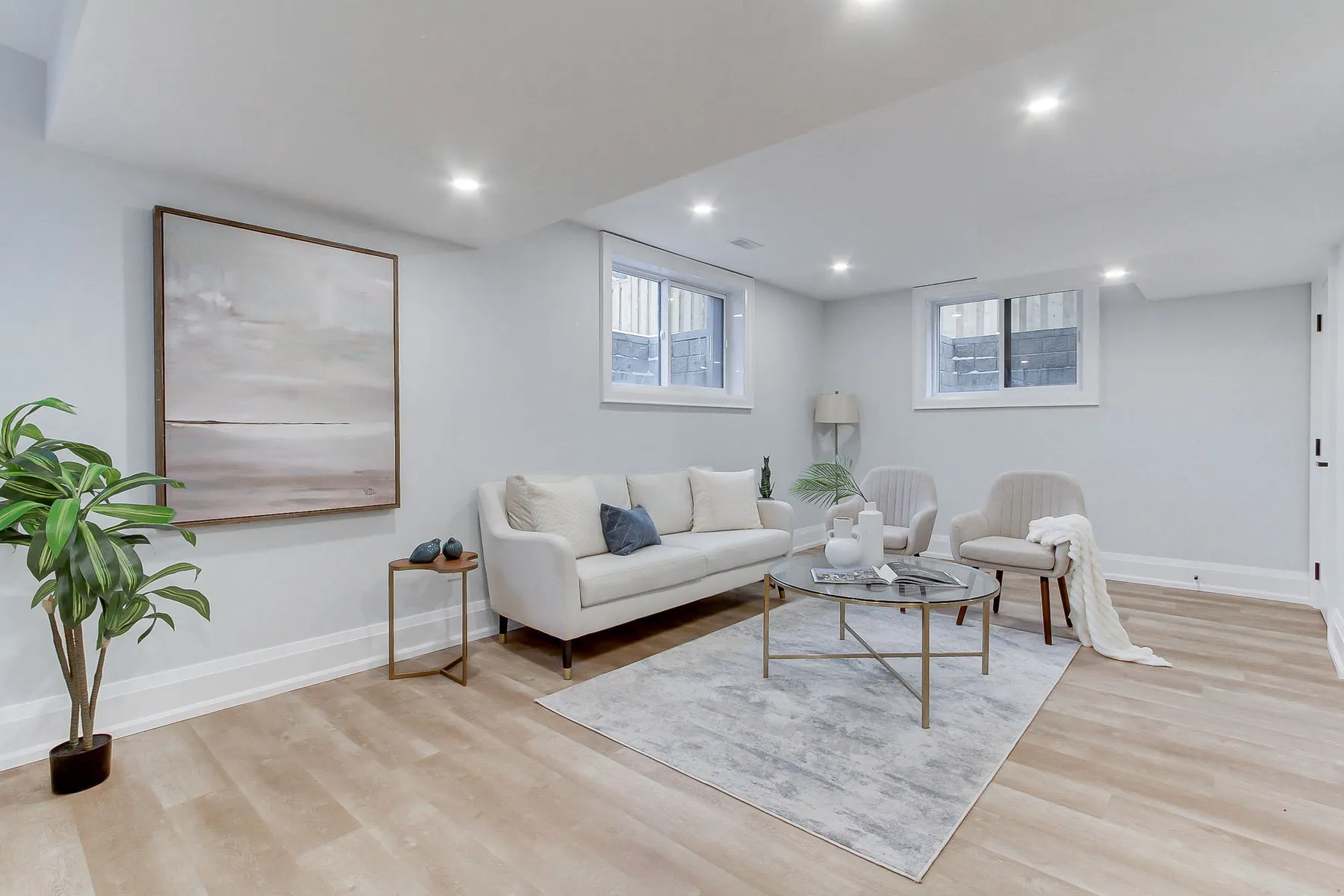
- Projects worth doing mainly for enjoyment: finished basements, garages, sunrooms and additions, decks and fences, landscaping. The AIC lists these under highest enjoyment value, not highest return.
- Projects that preserve value rather than add it: roof replacement, heating and cooling systems, windows and doors, electrical, structural repairs. These are about not losing value, and about a home that is sellable at all.
A new roof will not command a premium, but a failing one will cost you at the negotiating table. Budget the second and third groups for what they are. A finished basement can be the best money you spend for how your family lives, and still not be a resale-recovery play. Both things are true at once.
The neighbourhood ceiling: why Burlington’s market caps the recovery
Here is the part the percentage lists leave out. A renovation’s recoverable value is capped by what comparable homes near you actually sell for, no matter how much you spend or how good the finishes are. The AIC calls this over-improvement, and its own example is blunt: a $65,000 basement renovation in a neighbourhood where homes generally do not exceed $200,000 “may not provide the best financial return.” The brochure gives the same warning for personal features, using a custom wine room as the example. Unless a buyer happens to share your taste, you may not see that money again.
Call it the neighbourhood ceiling. Your street sets a rough upper bound on what any home on it will fetch, and finishes far above that bound tend to recover the least, because the buyer pool that would pay for them is shopping in a different neighbourhood.
That ceiling is worth taking seriously in Burlington right now. As of June 2026, WOWA’s Burlington market report, drawing on TRREB data, put the average detached home price at about $1.43 million, down about 2 percent year over year and close to 5 percent month over month, so detached values were softening on both measures. Apartments and condos told a different story, up more than 16 percent year over year. This is a point-in-time snapshot that will drift, so confirm the current figure before you lean on it. The takeaway is not a forecast. It is a reason to be conservative about high-end spec renovations in a segment that was not appreciating: when detached prices are not rising, the neighbourhood ceiling is doing more of the work in deciding what you recover.
The practical move is to match finish quality to comparable homes nearby rather than to the top of what a showroom can sell you. Before design starts, a professional appraiser (the AIC recommends exactly this in its brochure) or a local REALTOR can read the comparable sales on your street and tell you where the ceiling sits. That is a couple hundred dollars of advice that can reshape a six-figure decision.
Why U.S. “Cost vs. Value” numbers aren’t a Burlington benchmark
You will run into the Cost vs. Value Report from Zonda, and it circulates online as if the numbers were Canadian. They are not. It is U.S. data, covering 115 U.S. markets in 2025, with U.S. prices, labour costs, and buyer preferences baked in.
It is useful for the pattern, not the percentages. In that 2025 U.S. report, a midrange minor kitchen remodel was the only interior project in the national top five, recouping about 113 percent of its cost, while garage door replacement led every category at roughly 268 percent, and eight of the ten highest-recovery projects were exterior replacements rather than interior remodels. The lesson that travels across the border is the shape of it: smaller, functional, curb-facing updates often outperform large interior overhauls. The specific percentages do not travel. Do not drop a U.S. recovery rate into a Burlington budget.
That is also why you will not find a Burlington or Halton renovation ROI percentage in this post. None of the Canadian sources break their results out by city, so an honest read stops at national patterns and neighbourhood-level judgment, not a local number that does not exist.
Planning a renovation with value in mind
If resale recovery is part of your reasoning, a few disciplines keep you on the right side of the math:
- Keep finishes consistent with the neighbourhood rather than maximal.
- Be cautious with highly personal or niche features if you expect to sell within a few years.
- Get a written, itemized scope before you commit, so you are comparing real numbers, not impressions.
- Get a market-specific gut check from an appraiser or REALTOR against your street’s comparables before design work starts.
- Know the calendar before you start. A whole-home project is a multi-month commitment, and how long a full renovation actually takes shapes how long your money sits in the work.
One more note that is not our lane to rule on: how a renovation interacts with capital gains on a principal residence is a tax question, and worth putting to a qualified accountant rather than a builder.
Most of what decides whether a renovation recovers well is set before demolition, in the scope and the finish level relative to the street. That is the conversation worth having first, and it is worth having with someone who will tell you when a line item is not going to come back to you. That is also the point of what to ask before hiring a builder: the questions that separate a builder quoting your scope from one shaping it.
See how we approach home renovations, or start a scope conversation. We will walk the property and give you a straight read on what is realistic for your street.